
Trace Troy Previous Residents
Past residents leave different kinds of evidence in different periods. Oakland County’s modern land index is the fastest entry point for a recent transfer. Older deed books and the Tract Index can carry the chain farther. Troy Historic Village holds local township and city records, tax material, maps, and aerials that can explain what the address meant before modern portals. Directories and census schedules add household snapshots only after the property trail has been established.
| Source | Local coverage | Where held | What it can establish |
|---|---|---|---|
| Oakland Super Index | January 1964 to current | Oakland Register of Deeds | Recorded-instrument index; images or details may be paid |
| Books and Tract Index | Into the 1800s, retention dependent | Register of Deeds office | Older deeds, plats, lots, and metes-and-bounds research |
| Troy Township and City records | 1819–1955 and 1956–1969 | Troy Historic Village | Government records and local place context by appointment |
| THV assessments and maps | 1840–1866 assessments; 1872, 1896, 1906/08, and 1916 maps | Troy Historic Village | Land, tax-name, and road context |
| THV aerials | 1963, then 1974, 1980, 1990, 2000, and 2002 | Troy Historic Village | Building and landscape continuity |
| Federal census | 1790–1950 released | National Archives channels | Household information at an enumeration date |
| Directories | Exact Troy runs not verified | Library and history repositories | Annual or reverse address snapshots once a volume is confirmed |
For a recent question, begin with the current parcel and the recorded transfer. For a nineteenth-century question, start by defining the legal parcel and ask whether the Historic Village or the county’s manual records hold the earlier bridge. Note: an address found in a directory is a snapshot, not proof that a person stayed through the whole year.
Troy Parcel Card First
The Troy Parcel Information Center is the clean starting point for previous residents research because it accepts an address or parcel ID. The form warns searchers not to include street suffixes such as St, Dr, or Cir. Copy the result’s parcel ID, situs address, legal-description clues, owner or customer label, subdivision, block, lot, and last-sale information when visible. These details make it possible to compare later records without relying only on a street name.
The related Troy BS&A portal offers Address, Name, and Parcel Number routes. Its basic record is a reference source. Full detail may require a purchase or an account claim. A current owner or customer label is the beginning of a title search, not a claim about all previous residents or current occupants.
Troy Deeds Before 1964
January 1964 is the key online pivot for Oakland land research. The Super Index has computer coverage from that month forward. Its free index search can use a name, address, PIN, or advanced fields such as Grantor/Grantee, recorded date, instrument number, subdivision, block, and lot. An image or detail view may be paid, while the index itself is available to a guest.
Before that pivot, older books and manual tract records are held at the Register of Deeds office, subject to retention and manual-search limits. The Tract Index covers acreage or metes-and-bounds, subdivision lots, and condominium units. Its best search key is the Sidwell or parcel number. The office also accepts grantor-grantee work in person or by mail for $5 per name; it does not fax and does not search outside Oakland County.
Index comparison. A modern online result is quick but incomplete for an old address. The county’s retained books and tract records are the documented fallback when the date precedes the computer index.
Oakland Deed Chain Backward
A chain of title is a dated sequence of recorded ownership transfers. It runs backward from the present parcel record. Do not jump from a familiar surname to an older deed. Compare the legal description each time, because the same street can have many parcels and a historical deed may use a lot or acreage description rather than today’s mailing address.
- Pull the current Troy parcel data and copy the current owner or customer label, PIN, situs, legal description, subdivision, block, lot, and visible sale data.
- Search the Super Index by PIN, address, or legal description. Locate the purchase deed and record the instrument number, recording date, grantor, grantee, and legal description.
- Read the grantor as the transferring party and the grantee as the receiving party. Search the seller as an earlier grantee in an earlier date range.
- Repeat the comparison backward. If an address search fails, use subdivision, block, lot, or the Tract Index rather than guessing from a changed street spelling.
- When the online index ends, ask the Register of Deeds about manual books or tract research. Preserve each citation so that the earlier link can be rechecked.
- Grantor
- The party transferring an interest in a recorded deed.
- Grantee
- The party receiving the interest named in the deed.
- Legal description
- The parcel wording used in land records. It is usually more stable than a street string when an address changes.
- Chain of title
- The ordered, documented trail of transfers for the same parcel.
Legal Descriptions Bridge Troy
Plats show how a street address relates to a subdivision’s lots and blocks. Metes-and-bounds descriptions describe a parcel by its boundaries and measurements. Both are useful when a street name was abbreviated, a parcel number was reformatted, or a historical record predates a current address. The research did not locate an official Troy renumbering or renaming timeline, so it would be inaccurate to supply one from memory.
Historic map and road context can test a proposed match. Oakland’s 1908 Cross Atlas was donated to the Register of Deeds in 2022, preserved and digitized, and is available by appointment. Pair it with a deed’s legal description or the 1906/08 Troy Historic Village map. It is a historic bridge, not a replacement for a current GIS layer.
Troy Maps and Aerials
The Troy Historic Village resources are the local pivot when a property’s story moves beyond recent deeds. The reference library holds family-history, obituary, genealogical, first-landowner, assessment, burial, and veteran material. Its map sequence includes 1872, 1896, 1906/08, and 1916. Its aerial sequence begins with a museum-only 1963 image and continues with 1974, 1980, 1990, 2000, and 2002.
The Historic Village resource page is the source for this local-history entry point.
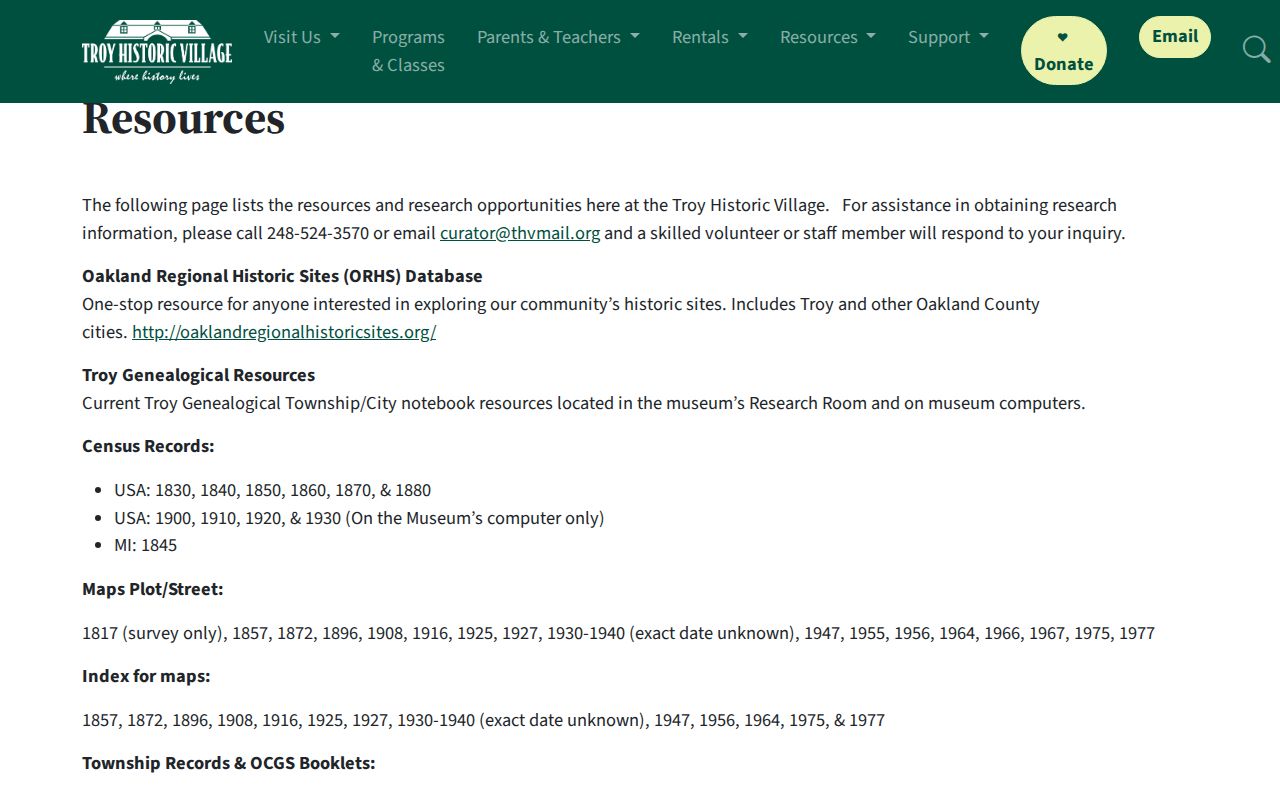
Appointment is suggested, and library books do not leave the facility. The Troy Township Records finding guide describes government-created records for roughly 1819–1955 and 1956–1969, open by appointment at 60 W Wattles Road. A current city financial statement uses 1821 for township organization, while the older county history and the finding guide use 1827. That source difference makes the repository and date of the record more important than a single founding slogan.
Troy Directories and Census
Owners are only one part of an address history. A confirmed reverse or criss-cross directory can place an address entry under its street and house number, then point to an alphabetical entry with printed household or business notation. Search the Troy Public Library catalog for Troy city directory, Oakland County directory, reverse directory, criss cross, Polk, telephone directory, obituary, and yearbook terms. Exact Troy publishers, years, and shelf numbers were not found in the official research and must be confirmed with the library or a local-history repository.
- Choose a verified directory year close to a deed transfer, permit date, or aerial change.
- Find the address in the reverse section, if that volume contains one, and record the printed name exactly as it appears.
- Check the alphabetical entry for any spouse, telephone, or business notation printed in that edition.
- Compare it with the nearest released federal census, checking the Troy Township or city boundary for the enumeration year.
- Repeat in five- or ten-year intervals while noting gaps. The collections themselves are discussed in the Troy city directory section.
The National Archives makes federal census schedules from 1790 through 1950 available under the 72-year rule. A census is tied to an enumeration date and geography, so it can support an address-era snapshot without promising an unbroken residence history.
Troy Permit and Probate Endpoints
Current Troy permit records can date construction, alteration, or the responsible applicant. Their online historical start date was not documented, so they cannot alone fill an older gap. Use a permit’s begin or end date and work description to narrow the period between deeds, maps, aerials, or directories.
At the end of a person’s recorded trail, an Oakland marriage or death research result can point toward a certificate path, obituary, burial material, or probate case. Oakland marriage research begins in 1827 and its online index reaches 1868 onward. Death research begins in 1867 and its online index reaches 1900 onward. Troy Historic Village holds local marriages from 1836–1884 and deaths or burial material from 1897–1938. Probate can name heirs or fiduciaries and sometimes an address, but it remains a lead that must be read in its own context.
Privacy in Past Resident Research
Previous residents research is for local history, family research, property curiosity, and estate questions. It should not be used to track a living person. A deed identifies a recorded transaction, not everyone who lived at an address. Directories can be late, census records reflect a single date, and an obituary or probate file should not be copied into a new personal dossier.
Michigan’s Address Confidentiality Program protects eligible people through a designated address and mail-forwarding arrangement. Do not try to discover an actual protected location by combining land, voter, or request records. Sensitive fields in recorded images, including signatures, financial-account numbers, and Social Security information, should not be repeated. Michigan stalking law covers a course of unconsented contact or harassment; public records are not an excuse.
Lawful use. Follow a Troy address backward only for personal, historical, family, or property research. Never use dated records to harass, intimidate, stalk, or expose another person.