
Troy City Directory Collections
Troy has a well documented historical-record shelf, but not a verified, published run list for a locally held directory volume. The online catalog is the first place to test a title, place, year, or subject. Library staff and on-site local-history resources must confirm whether a particular city, county, telephone, reverse, or criss-cross volume is held. The sources reviewed did not establish a Troy publisher, first or last year, call number, or digitized run. Nearby places with the same name are not substitutes.
| Collection | Years | Where Held | Access |
|---|---|---|---|
| Troy printed directory volumes | Exact run not verified | Troy Public Library catalog and local-history inquiry | Confirm title, years, shelf location, and format with library staff |
| Reverse or criss-cross directories | Exact Troy run not verified | Library catalog or local-history request | Ask about printed volumes, microfilm, or interlibrary loan |
| Troy Township and City records | 1819-1955; 1956-1969 | Troy Historic Village | Open by appointment under the finding guide |
| Assessment and tax records | 1840, 1848, 1856, 1858, 1864-1866 | Troy Historic Village reference resources | Appointment suggested; books do not leave the facility |
| Maps and aerials | 1872-1916 maps; 1963-2002 aerials | Troy Historic Village | Reference and museum access, with 1963 museum-only |
These collections are related, not interchangeable. A printed directory is an annual snapshot, while a township record, tax list, or map may answer a different question. The absence of a catalog result is also not proof that no directory exists. It may call for a broader Oakland County search, a format check, or a question about material that is available only in person.
Troy City Directory Shelf Checks
The Troy Public Library, at 510 W Big Beaver Road, is the local starting point for catalog verification. Its catalog phone is 248-524-3538. Search both direct terms and nearby forms: Troy directory, Oakland County directory, reverse directory, criss cross, telephone directory, Polk, R. L. Polk, obituary, yearbook, and local newspaper titles. A staff member can also identify whether a result is a physical book, microfilm, a database item, or an item that needs an interlibrary-loan request.
Use the Troy Public Library entry point before making a special trip.
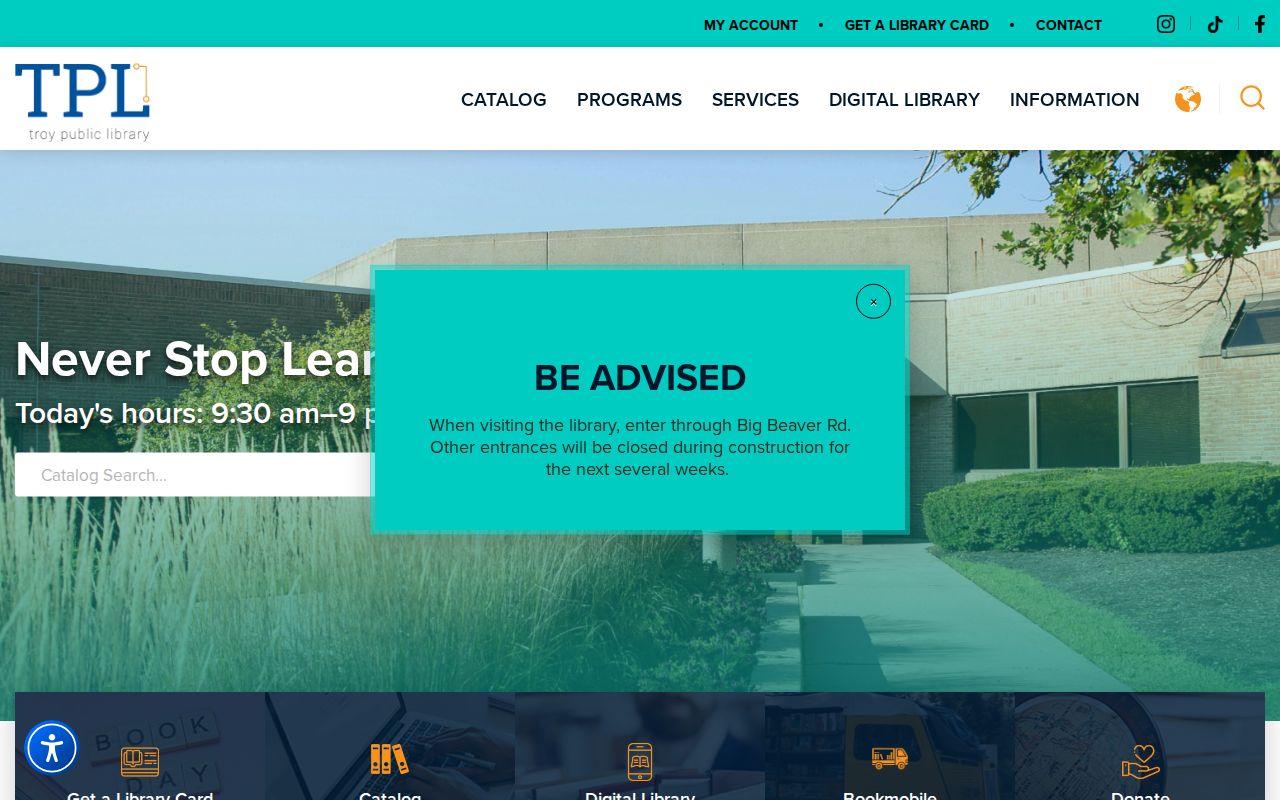
The library image is a starting point for local catalog work, not proof that a specific Troy directory year is available. The published research found no definitive local list for directory years, obituary-index years, newspaper microfilm years, or licensed genealogy databases. Ask about each item by title or record type instead of assuming it is on a shelf.
Reading a Troy City Directory Entry
The Library of Michigan city-directory guide describes the field pattern that a verified local volume may use. The page should be read as a printed record with its own conventions, not as a current household list. A name may be shortened, a spouse or household reference may be supplied, and an address can be a residence, business, or mailing location. The actual abbreviation key and typography for Troy still require inspection of a verified volume.
| Name | Surname and given name, often placed in an alphabetical resident section. |
|---|---|
| Household reference | A spouse or another household reference may appear when the edition prints one. |
| Address | Street name and house number may allow a later check in the reverse section. |
| Telephone | Included only when that edition printed a telephone field. |
| Occupation or business line | A historical entry can print this notation; it identifies the record’s wording, not a present-day status. |
| Owner, renter, or widow notation | Some editions use these marks or cross-references, so consult the volume’s own key before drawing a conclusion. |
- Criss-cross section
- The address-side arrangement of a directory, with streets alphabetized and house numbers in order. It supports an address-to-entry check.
- Householder index
- An index organized around the named householder or entry, rather than every possible person connected with an address.
- Abbreviation key
- The printed explanation of the volume’s shortened labels and marks. Photograph or transcribe it before interpreting entries.
The Michigan city-directory guide shows the reading conventions behind this Troy research path.
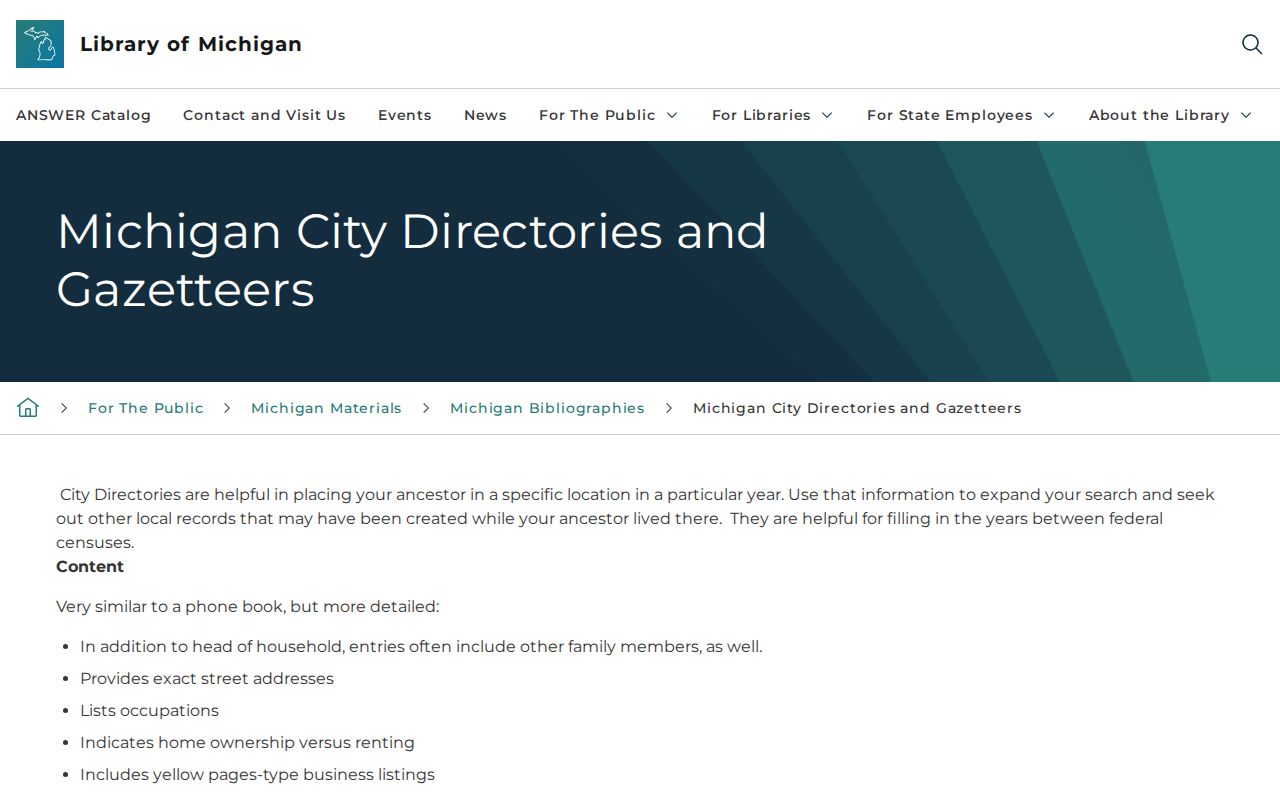
Use the guide to understand a volume’s structure, then let the particular Troy book control its abbreviations and fields. No real Troy entry image was verified in the source set, so no sample person or address is presented as a local directory transcription.
Troy Historical Record Shelves
Troy Historic Village provides the strongest hyperlocal archive for a family trail that cannot yet be tied to a directory volume. Its public reference library, family-history material, obituary and genealogical records, museum files, and research help are all relevant. Appointments are suggested, and reference books do not leave the facility. The Township Records finding guide identifies Troy Township and Troy City records for roughly 1819-1955 and 1956-1969, with government offices as creator and the Village as repository.
Specific local leads include first-landowner material; assessment and tax records for 1840, 1848, 1856, 1858, and 1864-66; limited births; marriages from 1836-1884; deaths from 1897-1938; burial material; and military-era records. Those records can help test a family name, a property connection, or a life event beside a printed-volume search. The finding guide gives a Troy contact point at 60 W Wattles Road and identifies curator Elizabeth Thornburg, 248-524-3570, for appointment-oriented historical-record questions.
Oakland County Directory Companions
When the Troy shelf is incomplete, move outward without losing the location. The Oakland County Historical Society supports family, business, and place research from its Pine Grove library in Pontiac. It was founded in 1874 and changed its name from Oakland County Pioneer and Historical Society in May 2025. Its usual library hours are Tuesday through Thursday, 11:00 a.m. to 4:00 p.m., and its contact number is 248-338-6732. This is a county research destination, not a substitute for a verified Troy volume.
Open the Oakland County Historical Society research page when a Troy catalog search needs a county-level companion.
The society can help with a place or family question, while the exact publisher and year of a Troy printed volume still need to come from a catalog record or the physical item. The Oakland County Genealogical Society research-facilities page also points researchers to Troy Public Library and other local resources; membership material is not a public resident list.
Troy Directory Research Timeline
Troy’s historical custody has a timeline even though its exact city-directory run does not. The key is to choose a dated source that matches the period being examined, then verify the historical geography. Troy Township formation is attributed as 1827 in the Historic Village finding guide and an older Oakland history, while a current Troy financial statement says the township was organized in 1821. City incorporation is recorded as 1955. Keeping those source labels visible is more accurate than selecting one unsupported founding date.
- 1819-1955 and 1956-1969: Troy Township and City records identified in the Historic Village finding guide.
- 1840-1866: Surviving Troy assessment and tax record years provide local name and land context.
- 1872, 1896, 1906/08, and 1916: Historic Village maps can check an address or road against its period landscape.
- 1963, 1974, 1980, 1990, 2000, and 2002: Aerials provide later structure and road context, with 1963 museum-only.
Note: The research did not verify a first Troy directory year, a publisher change, or a final printed Troy volume.
Trace Troy City Directory Households
A household trail works best when the address is stabilized first. A current or historical deed, parcel record, or legal description can help distinguish two people with the same name. Once a verified Troy volume is in hand, use the closest year to the question, then compare it with a nearby volume instead of treating one entry as a full history. The reverse section can pivot from a known address to a printed entry, and the alphabetical section can then reveal the edition’s cross-reference or household wording.
- Start with a deed, parcel record, or map that gives a stable Troy address or legal description for the period.
- Confirm that a particular directory title and year is actually held before relying on a catalog result.
- Check the reverse or criss-cross section for the address, then read the linked alphabetical entry and the volume key.
- Repeat in available five- or ten-year intervals, noting address changes, alternate spellings, and changes in the printed household reference.
- Pair each directory year with the nearest available federal census and the relevant deed, permit, obituary, cemetery, or probate lead.
The National Archives census resources follow the federal 72-year release rule, with 1790-1950 schedules available through National Archives channels. Check Troy Township or city geography for the census year, because today’s city boundary may not describe the enumeration area. A name disappearing from a directory may reflect a move, a death, a different spelling, an unlisted person, or a change in the record’s address type. It needs a second source before it becomes a conclusion.
Troy Historical Map Checks
A printed-directory address may need a map check before it can be connected to a modern parcel. Troy Historic Village holds maps for 1872, 1896, 1906/08, and 1916, plus aerial images for 1963, 1974, 1980, 1990, 2000, and 2002. Use them to test road placement, building continuity, and the changing landscape around an address. They do not prove who lived there, but they can explain why a later record uses a different street string or parcel context.
The Oakland Register of Deeds reports that the 1908 Cross Atlas was donated in 2022, preserved and digitized, and is available by appointment. It is a historical parcel and map lead, not a modern GIS layer. Michigan Digital Sanborn Maps is listed by the Library of Michigan as a statewide resource for 1867-1970, but exact Troy sheet years were not verified. Search for Troy or Oakland within the resource before citing a particular sheet.
Unverified Troy Directory Details
The most important limitation is plain: exact Troy city-directory publisher names, year runs, reverse-directory years, call numbers, digitization status, and a real local entry image were not verified in the official source set. The same caution applies to Troy Sanborn sheet years, local newspaper coverage, complete cemetery lookup access, and exact FamilySearch collection titles. A reliable historical search records those gaps instead of turning a general Michigan resource into a claim about a Troy volume.
For an older relationship lead, the Library of Michigan Oakland County guide identifies naturalizations from 1827-1906, marriages from 1827-1849, probate abstracts from 1822-1868, the 1845 state census, and the Birmingham Eccentric obituary index for 1878-1977. Those are documented county paths, not proof that a particular person appears in them. Keep the catalog title, volume year, page, and source location with every finding so later checks can reproduce the trail.