
Find Troy Neighbors Nearby
Different sources answer different block questions. The county parcel map establishes land around a Troy address. Troy property records can show a parcel’s owner or customer label and mailing information. Michigan voter information is governed by a separate identity-based lookup and request process. Association and civic sources may provide public context, but the research did not identify a public Troy-wide association roster. Start with the land record and do not fill gaps with assumptions about a household.
| Block source | What it can show | Access path |
|---|---|---|
| Oakland Property Gateway | Tax parcels, PINs, addresses, and map-layer context around the target | Free map search; reports or custom maps may charge |
| Troy parcel and BS&A records | Parcel, owner or customer label, situs, mailing data, tax and permit links | City portal; some detailed information requires purchase or claim |
| Michigan voter records | Permitted registration fields through the proper channel | Individual lookup or QVF records request; sensitive fields withheld |
| Neighborhood resources | Named association or planning-geography context | City-document or association follow-up; no public roster assumed |
| Historical collections | Older family, place, map, and directory leads | Library or appointment research |
An owner label, a tax mailing destination, or a voter match proves only what that record is designed to show. It does not prove that every person connected with the address is a neighbor or that every neighbor appears in a searchable public record.
Define a Troy Block
Set the scope before searching. For a close-door question, use parcels sharing a boundary with the target. For a street-side question, use the same side between two named cross streets. For a broader local question, record the nearest tax parcels and say that this is a chosen map scope, not an official neighborhood membership list. Roads, alleys, public parcels, common areas, and noncontiguous condominium parcels can make an on-screen result look closer than it is.
Troy’s planning material uses neighborhood nodes such as Crooks/Wattles and Livernois/Square Lake. Those are planning and economic-geography labels. They are helpful orientation clues in a square-mile grid, but they are not association rosters and should not be treated as proof that two addresses share a community organization.
Map Troy Neighbor Parcels
The verified official method is map search followed by parcel clicking. Search the target in Oakland Property Gateway, then pan and zoom along the parcel boundary. The viewer supports a PIN or property address, partial strings, partial PINs, and percent wildcards. It provides tax-parcel and other county map context, but the research did not verify a radius, buffer, or automated “neighbors” export. A manual parcel review is the supported route.
- Find the target address or PIN in the Property Gateway and confirm the correct tax parcel.
- Apply the chosen block definition, then click the immediately adjoining or selected nearby parcels one at a time.
- Record each parcel’s PIN, situs address, and legal-description clue before opening another portal.
- Use the PIN or address in the Troy Parcel Information Center or BS&A record to distinguish a map parcel from a tax or owner label.
- For the full records history of a named road, move to the Troy street directory rather than turning a block review into a streetwide roster.
Homestead or mailing information can be a tax-administration clue, not a confirmed presence at the property. Keep the visible field labels intact in notes so that a later reader knows whether a result came from a parcel, a mailing record, or a title record.
Michigan Voter Limits for Troy
The Michigan Voter Information Center requires first name, last name, birth month, birth year, and ZIP for its name lookup, with a separate driver-license-number route. It can confirm an individual’s registration and election information within the tool. It does not let the public browse every voter on a Troy block by street address.
The QVF records-request form is a different channel. It allows geography choices such as a jurisdiction, ward, or precinct and may return name, residential or mailing address if available, year of birth, registration date, status, voter ID, and requested history. It withholds full date of birth, driver-license or ID number, phone, email, signature, last four Social Security digits, and protected information. Delivery choices are pickup, FTP, or mail, with a fee and scope quote to obtain from the Department of State.
Note: a permitted geographic request remains subject to confidential-address protections and does not create a reason to compile or republish sensitive data.
Troy Community Leads
Only a small number of community leads were verified in the research. A city planning document names the Woodlands of Troy Homeowners Association, but no public member directory, contact list, or join process was located. The city’s neighborhood nodes are not associations. Troy Historic Village and the Oakland County Genealogical Society are research resources, not public directories of people. This distinction keeps a useful local lead from becoming an unsupported claim.
| Resource | Verified Troy scope | Directory or contact status |
|---|---|---|
| Woodlands of Troy Homeowners Association | Named in a city planning document | Member directory not located; follow up with the association or city document |
| Neighborhood Nodes | Planning and economic geography, including Crooks/Wattles and Livernois/Square Lake | Not an association or membership list |
| Troy Historic Village | Local family, place, map, and history research | Appointment and reference inquiry, not a block directory |
| Oakland County Genealogical Society | County research-facility guidance | Membership information is not a public people list |
| Civic groups and congregations | Potential local leads | Specific verified Troy rosters were not located |
Troy Civic Address Context
The Troy City Council page is a public civic route for matters that affect an area, rather than a source for identifying households. Council and planning material can provide official context for neighborhood nodes, public projects, or city decisions. It does not establish a private association roster or a list of people attached to nearby parcels.
The City Council page supplies the source for this civic-context view.
For a location-specific nonemergency city issue, a citizen request may record the address or intersection and the city’s response. That creates an administrative record under the city’s access and retention rules. It is not a substitute for parcel ownership, voter registration, or a community directory.
Troy Requests by Location
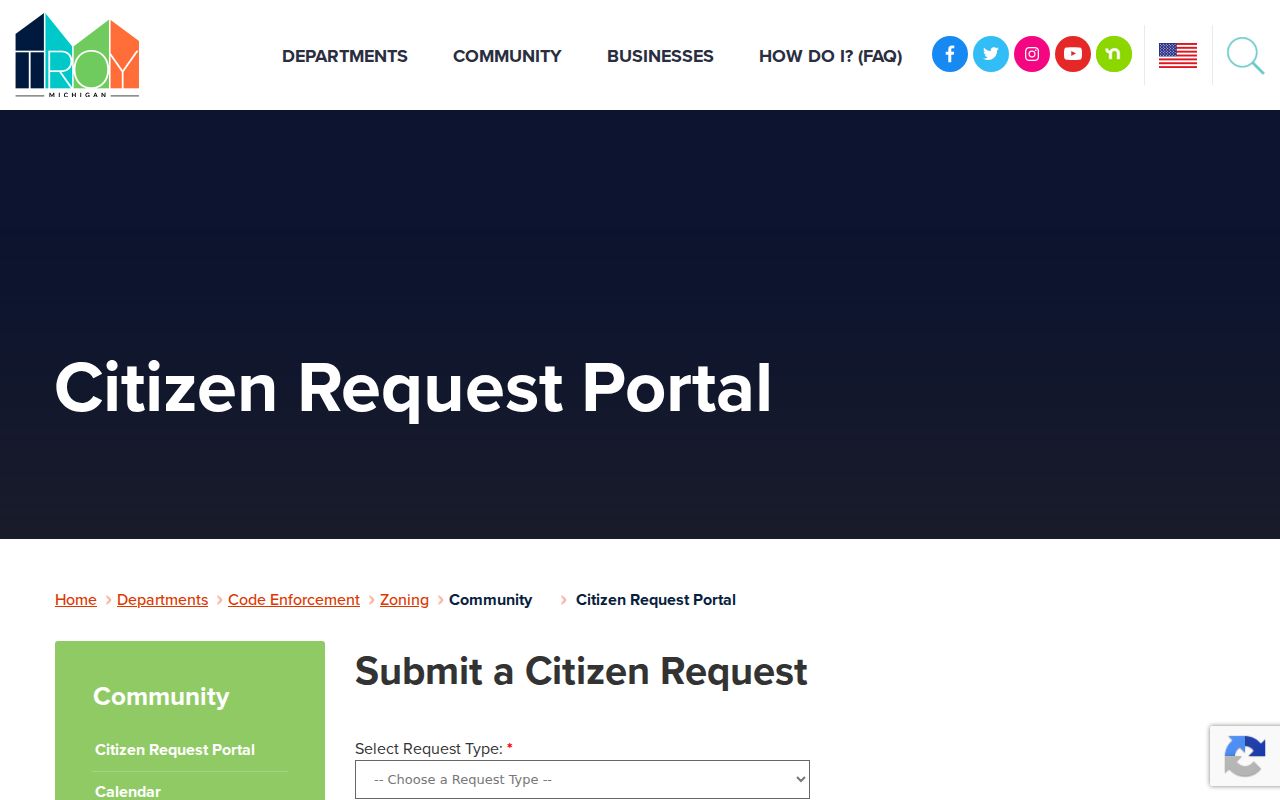
The Troy Citizen Request Portal offers an official location or intersection intake and request-status workflow. It can help a person report or follow a city matter connected with a block. It should be used for its administrative purpose, not to identify the people who live around the reported location.
The Troy Citizen Request Portal is the source for this address and intersection intake view.
Where a public record ends, use its documented fallback. For an older address or family question, the Troy Public Library, Troy Historic Village, Oakland County Historical Society, and county record offices are the research paths. Private rosters remain private unless the organization itself publishes them.
Official and Commercial Neighbor Sources
Official records are narrow by design. That makes their limits useful. Commercial neighbor-lookup products are a separate data-broker category that may combine public records, old addresses, and purchased information. They can merge people with similar names, miss protected residents, and carry stale connections. A result that appears broader is not necessarily better evidence.
| Source category | Strength | Limit to keep in view |
|---|---|---|
| Official parcel and deed records | Directly tied to land, transaction dates, and legal descriptions | Shows ownership or recorded parties, not a complete household |
| Michigan voter-access channels | State-controlled registration data through permitted routes | Not a public block browser; protected fields and records are withheld |
| Published association information | May describe a community’s stated public activities | Not a reason to assume a member list is public or current |
| Commercial neighbor products | May provide broad, mixed-source leads | Not authoritative; can be stale, incomplete, or match the wrong person |
Historic Troy Block Context
Maps and aerials can show whether the physical block existed in the same form at different dates. Troy Historic Village holds maps for 1872, 1896, 1906/08, and 1916 and aerials for 1963, 1974, 1980, 1990, 2000, and 2002. These resources can test a proposed road, building, or parcel connection before an old directory or census record is assigned to it.
The research did not verify a citywide historical community-directory run, an automated parcel-neighbor export, or public rosters for local civic groups. That gap matters. For an address-history question, use a confirmed property trail, map evidence, and the library or Historic Village appointment route instead of trying to manufacture a block list from unrelated public material.
Limits on Troy Neighbor Searches
Troy neighbor research may establish the parcels selected around an address and the public land or civic records tied to them. It cannot reveal every person at an address, a utility customer, a delivery recipient, a private association member, or a confidential voter. A property mailing address may be outside Troy and still be correct for tax correspondence. It is not proof of where an individual is present.
Michigan’s Address Confidentiality Program supplies eligible participants a designated address and protects the actual location. Do not attempt to reverse a designated address through parcels, public requests, or voter records. Driver information also has separate privacy protections. Michigan stalking law prohibits a course of unconsented contact or harassment, and public-record access does not override that rule.
Lawful use. Use a Troy neighbor lookup for community awareness, personal research, and civic questions. Never use public records to watch, harass, intimidate, or expose another person.